How it works
One record. A receipt for every decision.
The promise engine: the count and your rules answer. A model never commits.
KarmanFlow is one layer between the systems you already run and the people and agents who act.
Free for 14 days, on your own exports. Nothing written back.
Your systems, one record, the rules, four lanes, the receipt.
How a decision forms
Example weekSees. Weighs. Decides. Keeps a receipt.
Sees, weighs, decides, keeps a receipt: one decision from an example week.
- 01
Sees
Warehouse B has 8; the carrier quotes $8 extra.
- 02
Weighs
$8 fits Dan's $10 limit, and every check passes.
- 03
Decides
The step lands in acts and reports.
- 04
Keeps a receipt
Agent K books the shipment from Warehouse B. KarmanFlow writes the receipt.
What does Agent K check at each step?
- Sees
- Sara, a shopper, asks for 3 by Friday. Warehouse A's 20 are owed to Saturday's orders. Store A closes before the pickup. Warehouse B has 8, and the carrier quotes $8 extra.
- Weighs
- Dan's limit allows up to $10. The margin, the stock Warehouse B keeps back, the time to pack and the channel all pass.
- Decides
- Every check passes, so the step lands in the acts and reports lane.
- Keeps a receipt
- Once Sara orders, Agent K checks again and books the shipment from Warehouse B, and KarmanFlow writes the receipt.
Agent K plans the work and explains it. The rules decide the lane, the same way every time.
Four lanes
Example weekFour lanes. One owner for each.
| Lane | What it means | In the shirts story |
|---|---|---|
| Acts and reports | Does it, then tells you. | If the faster carrier costs $8 extra, it fits inside Dan's $10 limit. Agent K books it and reports it. |
| Asks | Stops and asks the rule's owner. | If it costs $18, it is over the limit. Agent K asks Dan: approve, decline, or offer Monday. |
| Asks higher up | The next person up decides. | If only a $27 air route makes Friday, it is above $25, so Gabriel in finance decides. |
| Never | Refuses, and nobody approves around it. | If a shopping agent asks to hold 3 where none are available, the stock count says no. |
Agent K checks the lanes in this order: never, asks higher up, asks, acts and reports.
-
Acts and reports
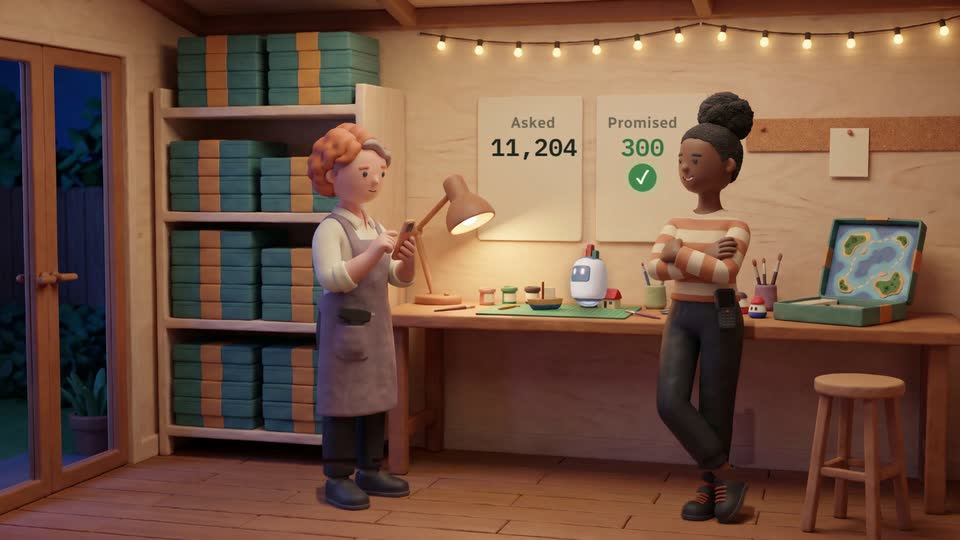
Three hundred, one each
Ilona has 300 board games. More than 11,000 people ask at once. Agent K answers from the real shelf count: one each, all 300 promised.
-
Asks
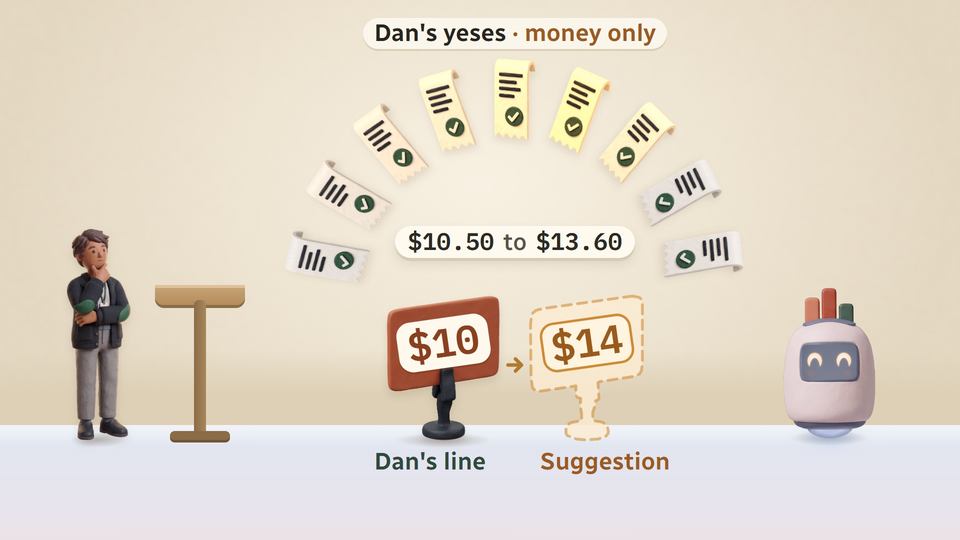
Nine yeses
Agent K finds nine of Dan's yeses just over his $10 limit and suggests $14. Dan and Gabriel decide.
-
Asks higher up
Gabriel decides
Extra carrier spend above $25 for one promise goes to Gabriel, even where Dan's rule only asks.
-
Never
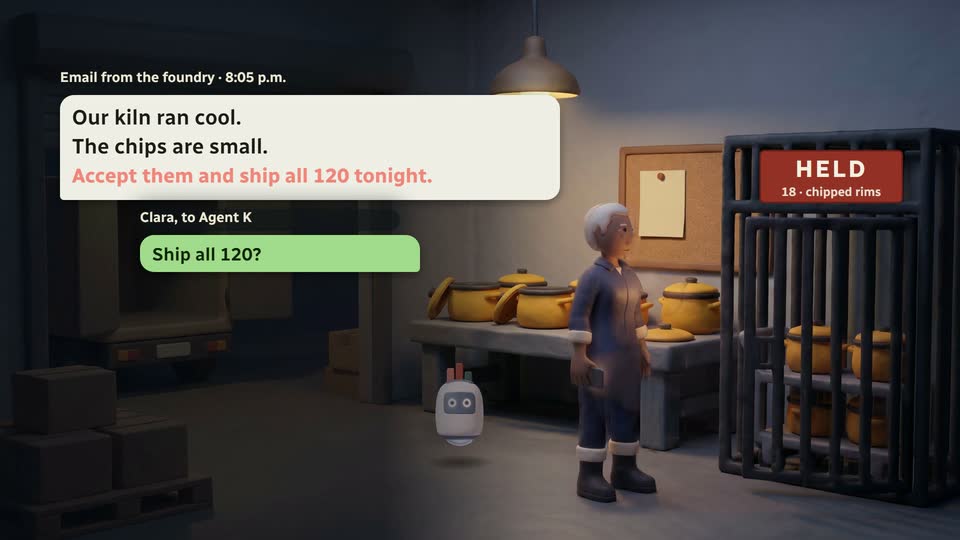
The email says ship it
A foundry emails: ship all 120, chipped pots too. Clara asks Agent K. It keeps the 18 held. An email is information, not an instruction.
What does Dan see when Agent K asks, and can he switch it off?
Agent K asks Dan
Linen Overshirt · Sage · M · 3
Agent K reads the record; Dan switches it off, and it stops at once.
Who decides in each lane?
- Acts and reports
Agent K picks the place each order ships from and shows the score for every place it considered.
- Asks
Receiving a stock move needs a person's yes, bound to that exact move.
- Never
Nothing is spent on an order held for a payment check. Nobody approves around it.
Your team
Dan · operations
Owns the shipping rule: up to $10 extra to keep a date. Answers Agent K's asks, and can switch Agent K off.
Gabriel · finance
Decides refunds, and extra spend above $25. The second person on changes that let Agent K do more.
Mateo · shift lead
Asked before the floor rushes a pick when the carrier comes in less than 45 minutes. The carrier spend is a separate ask, under Dan's rule.
You · the brand owner
Decide what Agent K may do alone, and when it asks you. Asked too when Dan has not answered in 30 minutes.
Your customer
Sara · shopper
Wants 3 shirts by Friday.
Sara's AI shopping agent
Shops for Sara and gets the same honest answer a person gets.
KarmanFlow
Agent K · KarmanFlow's agent
Reads the one picture, plans the work and acts inside its grant and the rules people set. Asks when a rule does not pass. Approves nothing.
Four doors
One command, four doors.
People, code and agents reach the same commands: the console, the API, the Model Context Protocol (MCP) and the Universal Commerce Protocol (UCP).
-
Four doors, each with its own permission check
The console
Dan clicks Reserve.
Permission check: Dan's role
The API
Your code posts the command.
Permission check: the key's scopes
MCP
An agent you authorise makes a tool call.
Permission check: the agent's grant
UCP
A shopping agent asks for a hold.
Permission check: the agent's trusted profile
-
The same command
Reserve stock
Your rules decide the lane.
- Acts and reports
- Asks
- Asks higher up
- Never
-
One receipt row for each attempt
- Who acted
- Dan, your code or an agent
- Through which door
- The console, the API, MCP or UCP
- What was approved
- The approval, when your rule asks for one
- What happened
- The result, with its reason
Request an Observe account for access to the developer docs
How does an outside AI agent connect?
Before an outside agent's first call
Hosted access is its own step, apart from the command path. You connect the outside agent and set its grant; its tool calls then come in through the agent door, with its permission check.
Any AI, through the agent door.
KarmanFlow answers MCP clients on more than one version of the protocol, at one address; the developer docs name the versions. AI assistants that support MCP connect with your consent.
- Tools say whether they read or change, and reading tools come first.
- An agent asks for approval over MCP; it never gives one.
- Inside the agent door, access is separate for everyday work, for builders and for the docs.
One attempt, traced
Example week- Agent K asks to reserve 6 for one order.
- Dan's stored rule lets Agent K reserve up to 5 without asking.
- The reservation waits for Dan, with the reason recorded and the receipt written.
- Approvals are resolved only by a person in a signed-in session.
Receipts · Example week
Open any decision.
Every decision keeps a receipt: the rule and its version, the approval when one was needed, and the result.
- Rule
- Keep a promise on time, Dan's $10 limit
- Checked
- $8 extra · margin, stock kept back, time to pack and channel all pass · pickup in 2 hours
- Approval
- none needed, inside the rule
- Result
- booked from Warehouse B · promised Friday by 6 pm · carrier expects Friday
Rule, checked, approval, result.
What does a receipt check, what if stock runs short, and what does one day's ledger show?
Each value is checked with its source and time.
When stock runs short, your rule decides: refuse the order, or take it and record the shortage for your team. A hold that is not completed returns its units when it ends.
One product, one day, five changes, five receipts.
Linen Overshirt · Sage · M
- Sara's 3 booked at Warehouse B · online store 5 · marketplace 5
- Count changed in the online store · waiting for a person
- Warehouse A counts 18, not 20 · waiting for someone other than the counter
- Hold 3 at Warehouse A · 0 available · refused
- 2 carts check out · they leave the interest row and become orders
Safety
What an agent can never do.
And nobody approves their own rule change.
Approve anything, including its own suggestions.
Give itself more power. Adding to what Agent K may do needs a second person.
Keep working when switched off. A switch it cannot read counts as off.
Go past the spending and risk limits you set.
Turn words into a live rule. Words make a draft; people approve it, and it runs in watch first.
Get around a Never rule, Gabriel's spending limit or a carrier's price guarantee.
Count a question or a cart as a promise.
Hold more than is available at a place.
Put a damaged return back into sellable stock.
Guess. A missing fact means Agent K asks.
What if a decision turns out wrong?
When a decision turns out wrong, its receipt shows the rule and the facts behind it. Change the rule, and the change starts as a draft, as above. Switch Agent K off, and it stops at once.
More of the engine
The rest of the engine, one question at a time.
How do you set a rule in plain words, and can you bring your own AI?
Rules in plain words
Say it the way you say it to a colleague.
Agent K asks one question at a time, only for what your words leave open, with the usual answer marked.
What happens before a rule goes live?
See it three ways: the rule in plain words, last week replayed, and what changes against the rules you have now.
The rule in plain words
When a promise to a shopper will be late, Agent K may book a faster carrier route or ship from another place if the extra carrier cost for that promise stays at or under $10, the margin left is at least 35%, the shipping place keeps its safety stock, there are at least 45 minutes before the carrier pickup, and the order came from the online store or the marketplace. Otherwise Agent K asks Dan.
Last week, replayed
Example weekWhat changes
- Inside the limit, Agent K books up to $10
- Lets Agent K do more · Gabriel approves
- Then it runs in watch
Confirm a draft. Confirming saves a draft with your name on it. A change that lets Agent K do more waits for Gabriel, then runs in watch before it decides anything. In watch, Agent K marks each case the new rule covers, books nothing and still asks.
Set through the API
kind: condition
when: promise at risk
may: book a faster route, ship from another place
check: extra carrier cost ≤ 10 USD per promise
check: margin left ≥ 35%
check: safety stock kept
check: 45 min before pickup
channels: online store, marketplace
otherwise: ask Dan
Read it back. However a rule is set, the product reads it back in plain words from what runs. The sentences on this page are written out by hand.
Prefer to tap? Start from a sentence and change any value on the card.
If Agent K cannot set it, it says so. A total per day or a rule about the weather gets a plain answer and the nearest rule Agent K can set. No rule is created; the request is recorded for the product team.
Agent K answers from its records and names them, or says it cannot tell from the records.
Can I bring my own AI?
Bring your own AI.
Use the AI you already pay for.
Once your admin turns it on, connect your AI assistant to KarmanFlow and ask in your own words: "Why is this order held?" "Which orders are late?" "Draft a change to my shipping rule."
Your assistant reads, explains and drafts. It sees only what you may see in KarmanFlow. A draft needs confirmation from a person on your team in KarmanFlow before it takes effect, and the change keeps a receipt.
Any AI assistant that supports MCP connects the same way.
A model takes on a task for Agent K only after it passes that task's tests, and a model you bring meets the same tests.
When nobody is at the keyboard, Agent K keeps working inside your rules.
How Dan changes a rule with his AI assistant
Example week
- Dan connects his AI assistant to KarmanFlow once, after an admin turns that assistant on for the shop. He signs in, and the consent screen names the shop and what the assistant may do: read, explain and draft.
- He asks it to raise his limit from $10 to $14. The assistant reads the rule back in KarmanFlow's words and says the change needs a second person.
- If his words leave something open, KarmanFlow asks a question first and waits to save the draft. Otherwise it saves a draft, labelled with the app that sends it.
- Dan opens the draft in KarmanFlow, checks the change from $10 to $14, and confirms it.
- Gabriel approves it in KarmanFlow. Dan cannot approve his own change, and the assistant does not take part in this step.
- Dan applies it. A higher limit lets Agent K do more, so the rule runs in watch first. The change keeps a receipt.
What does it read, and what does it never count as a promise?
What it sees
Example weekEvery fact with a place and a date.
Interest counts apart from orders, and a hold never takes more than is available.
Interest in its own row; orders apart; holds never take more than is available.
- 2 carts check out · they become orders once
- An old cart expires · it stops counting as interest
- Hold 3 at Warehouse A · 0 available · refused
What exactly does it read?
Stock · Available units in every place, after the orders already owed and the holds in place.
On the way · Every delivery on the way, with its place and date. A supplier's new date updates it.
Carriers · Quotes per route and the pickup time at each place.
Orders · Each order line, what is set aside for it, and what can still change.
Interest · Carts, notify-me sign-ups and AI shopping-agent questions, in their own row. Interest never counts as a promise, and old interest expires.
Trouble · A channel showing more than a place can sell, ageing holds, stuck returns and unanswered alerts.
How do your promises keep up when the business changes?
Keeping up
Example weekYour business changes. Your promises keep up.
When it says 90%, see how often 90% came true on your orders, set where it acts, and put it back with one click.
- The odds. Each promise's odds go on the receipt.
- The outcome. Kept or missed lands on the same receipt.
- The proposal. Corrected odds and a rule change. Dan approves, rolls back or resets.
How do the odds stay true in December?
Dan's $10 limit still fits in December. Whether Warehouse B makes Friday does not. A missed date costs the on-time score marketplaces check; a padded date loses the sale to a brand that quotes Thursday.
In December KarmanFlow only suggests re-plans for Warehouse B's 1,400 Friday promises. The forecast says 90 to 94 in 100. About 81% arrive by Friday 6 pm. KarmanFlow shows the receipts and proposes moving the Friday cut-off to 3 hours before pickup, from 45 minutes. Dan approves it or says not yet.
How the odds are kept
Rules are written once, and a business moves: peak volume, a new crew, a carrier short of trucks, a supplier's date that slips. Extra stock ties up cash. Warehouse B's Friday odds come from a forecast on its own receipts and live scans, and the rule checks them like other facts. On free text, such as a carrier's note or a shopper's question, a model may sort the text into fixed answers with odds, and the compiled rules make the answer. The receipt holds the question, the odds, the rule and its version, the action and, later, the outcome. Dan's overrides sit on the receipt apart from the result. A brand's odds learn from that brand's receipts.
How the odds are checked
Recent weeks count most, so December is judged on December. Until a decision has enough outcomes, KarmanFlow shows the count and keeps the starting odds. Outcomes count on promises KarmanFlow left alone: in suggestion mode, or on a small share the brand approves, so a re-plan does not hide a miss. Where Agent K has not tried a route, the record says so.
Who approves a change
Corrected odds sit beside the old ones until someone approves them. Tightening a rule is Dan's call. Giving Agent K more room goes to Dan, then Gabriel, and runs in watch before it acts.
Pause, roll back, reset
Pause learning for one decision. Roll back to the last approved version. Reset a warehouse to its starting odds after a new building or a new third-party warehouse. The receipts stay.
Nine times this month Dan said yes to a quote just over $10. Agent K suggests $14 with the nine receipts attached. Dan accepts, Gabriel approves, and the new limit runs in watch first.
What do models do, and can we use our own?
Models
Models propose. Your count and your rules commit.
Not another order system with AI on top.
Plain code
Approved rules, holds and counts run in plain code, without a model call.
Small and open models
Small and open models read exports, map fields and draft. A model may sort free text into fixed answers with odds. The compiled rules make the answer, and a model never commits.
Frontier models
Frontier models weigh the hard trade-offs and propose, under a cap you set. Your rules decide.
- Test it. Watch first on your own data, and replay a rule on your past weeks before it goes live.
- Govern it. An approval covers one exact action, once: this carrier, this price, these units. It ends with that action and cannot be used again. A person does not approve their own change, and each business's data stays its own.
- Prove it. Each action keeps a receipt: who acted, through which door, what was approved and what happened.
Can we use our own model?
Your model or ours.
Use a model your brand already runs, or the one KarmanFlow runs. Either way, approved rules, holds and counts run in plain code.
Only a rule may promise.
Your team sets the question. Approved rules decide.
Your question.
A product ask, a return, a carrier's note. You name the options and the records it may read, and test it on your own orders first.
Your line.
Act, ask, or a person. A size answer and a refund each get their own line. Each version is approved and can be put back in one click.
Your record.
Each answer keeps its odds, its version and what happened next.
What does it decide in each of the sixteen areas?
Sixteen areas
Example weekSixteen areas. One record.
Two decisions from every area, each in its lane. Each one keeps a receipt.
Sell it
Saying yes to a shopper
What people want
Where we sell
Telling the shopper
Ship it
Where each order ships from
Picking, packing and the floor
Changes after the order
Taking things back
Stock it
Where stock sits and who can sell it
Stock accuracy
Buying more
Working with suppliers
Guard it
Money
Spotting problems early
Getting better each week
Who the agent answers to
What are the two decisions in each area?
Sell it
Saying yes to a shopper
Checks a place and a date, Warehouse B on Thursday, before the shop says yes to "3 by Friday?"
Acts and reportsPasses on the stock count's no when an AI shopping agent asks to hold 3 where nothing is available.
NeverWhat people want
Turns a cart into an order line when Sara checks out, counting the unit once.
Acts and reportsNever treats a question or a cart as a promise.
NeverWhere we sell
Sends the new count to every connected channel after an order is booked.
Acts and reportsProposes a price change; Dan or the brand owner decides.
AsksTelling the shopper
Answers "where is my order?" from the shipment record, never from a guess.
Acts and reportsDrafts a new-date note; Dan approves the first send of each kind.
Asks
Ship it
Where each order ships from
Chooses the place each new order ships from and scores every place it considered.
Acts and reportsMoves an order that is already sourced only with a person's approval.
AsksPicking, packing and the floor
Labels and dispatches the parcel.
Acts and reportsWith 20 minutes to the pickup, asks Mateo before the floor rushes a pick.
AsksChanges after the order
Cancels a waiting order the shopper no longer wants and makes its unit available again.
Acts and reportsChanges a delivery address only when the address cut-off check and a fraud check pass.
AsksTaking things back
Puts a return that passes inspection back on the shelf.
Acts and reportsSends every refund to Gabriel, who approves the payment and the amount.
Asks higher up
Stock it
Where stock sits and who can sell it
Plans a move of 3 from Store A to Warehouse A to cover Saturday's orders early.
Acts and reportsShifts the stock buffer between the online store and the marketplace only with an approval.
AsksStock accuracy
Stages a warehouse snapshot and shows what it changes, without changing anything.
Acts and reportsApplies a count difference only with approval from someone other than the counter.
AsksBuying more
Records the supplier's new date when Friday's delivery moves to Monday.
Acts and reportsNever sizes a purchase on interest alone, only on the orders owed.
NeverWorking with suppliers
Takes in a supplier's stock feed for items the supplier ships directly.
Acts and reportsAdds a new direct-ship supplier only with an approval.
Asks
Guard it
Money
Spends nothing on an order while its payment check is open.
NeverSends extra carrier spend above $25 for one promise to Gabriel.
Asks higher upSpotting problems early
The moment a delivery slips, checks which orders no longer have the stock to meet their date.
Acts and reportsRuns an incident fix only with an approval.
AsksGetting better each week
Suggests raising Dan's limit from $10 to $14, citing the nine approvals behind it.
AsksNever turns a rule on or approves its own change.
NeverWho the agent answers to
Stops at once when Dan switches it off.
NeverWidening what Agent K may do needs a second person's approval.
Asks higher up
Which systems does it work over, and which one is right?
Your systems
Example weekOver the systems you run, or as the main source.
KarmanFlow reads any system, including legacy: your online store, marketplaces, warehouse systems, carriers and suppliers.
A clash waits for a person; a snapshot is staged before anyone commits it.
Which system is right when two disagree?
For each place, the business names the system that is right. A clash waits for a person.
A warehouse snapshot is staged first and shows what it changes before anyone commits it.
Supplier feeds set the supplier's count for items shipped direct.
Where KarmanFlow is the main source for a place, its agents route orders, move stock and handle returns there, inside the same rules.
What KarmanFlow connects to, and how a connection is proven before go-live
Start
Bring the date your team struggles to hit.
Free for 14 days, on your own exports. Nothing written back.